Indonesia




Jawaban Singkat
Marmer dan granit mengalami kerusakan yang berbeda selama pengiriman, sehingga pengemasannya pun harus berbeda. Sebagian besar informasi pengemasan ekspor di industri ini ditulis untuk "batu alam" sebagai satu kategori, dan di situlah banyak kerusakan dimulai.
Marmer adalah batuan karbonat, lebih lunak daripada granit dan lebih lemah di bagian tepinya. Kerusakan yang kita lihat pada marmer hampir tidak pernah berupa lempengan yang retak di tengah. Kerusakannya berupa pinggiran yang terkelupas dan sudut yang patah, dan itu berasal dari pergerakan lempengan di dalam kemasannya sendiri. Bundel dengan celah 10 mm di dalamnya akan menyebabkan marmer terkelupas di jalur yang tidak memengaruhi granit.
Marmer yang dipoles juga lebih mudah tergores. Dua permukaan yang dipoles yang saling bergesekan selama empat minggu akan mengurangi kilapnya. Permukaan yang dipoles yang dibiarkan bersentuhan dengan logam telanjang, atau dengan uap air yang terperangkap, dapat menyerap noda yang tidak akan hilang meskipun dipoles ulang — pada material berwarna putih atau abu-abu muda, permukaan tersebut sudah tidak bisa diubah lagi.
Ada tiga hal yang mengatur cara kita mengemas marmer. Bundel harus rapat tanpa pergerakan internal. Setiap permukaan yang dipoles harus dipisahkan dari permukaan berikutnya. Dan tidak ada permukaan yang dipoles yang bersentuhan langsung dengan kayu polos, logam polos, atau lantai. Semua hal di bawah ini mengikuti ketiga hal tersebut.
Tiga sistem mencakup hampir semua produk marmer yang kami kirim. Sistem mana yang Anda dapatkan bergantung pada bentuk produk, bukan ukuran pesanan. Ini adalah sistem yang kami gunakan untuk...Kami menyediakan lempengan marmer dan potongan sesuai ukuran..
| Jenis kemasan | Digunakan untuk | Struktur | Batas beban |
|---|---|---|---|
| Bundel rangka A kayu ganda | Gergaji potong besar, 2 cm dan 3 cm | Kayu ukuran 50×50–70×70 mm, alas 80×80 mm, ruang bebas forklift ≥100 mm | ≤ 2,5 ton per bundel |
| Peti kayu | Potongan sesuai ukuran, ubin, potongan proyek | Alas 18–25 mm, dinding 12–18 mm, lapisan EPE 10–20 mm | ≤ 1,5 ton per peti |
| kotak busa di dalam peti kayu | Ubin tipis | Dibungkus dengan busa terlebih dahulu, kemudian dimasukkan ke dalam peti seperti di atas. | ≤ 1,5 ton per peti |
Itulah konstruksi standar. Versi yang diperkuat tersedia untuk material bernilai tinggi atau berukuran besar — lihatapa yang dapat Anda tentukan dalam pesanan pembelian Andadi bawah.
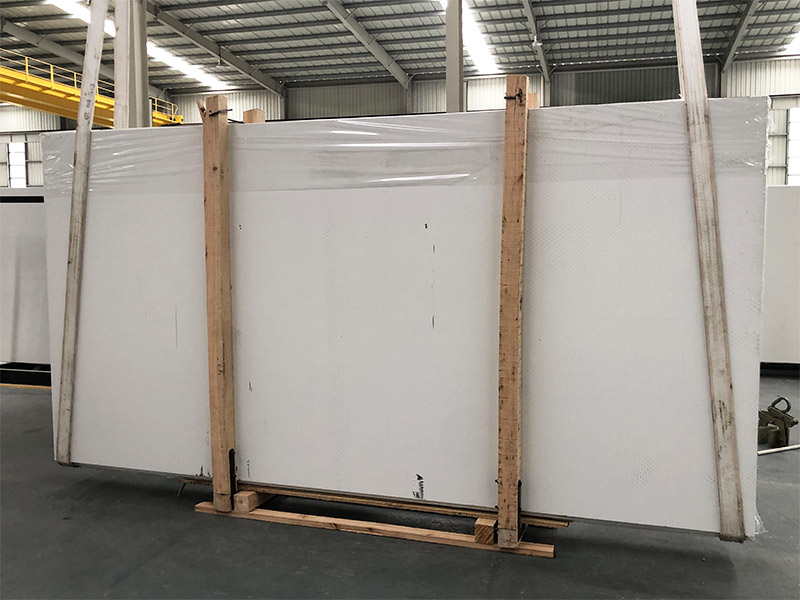
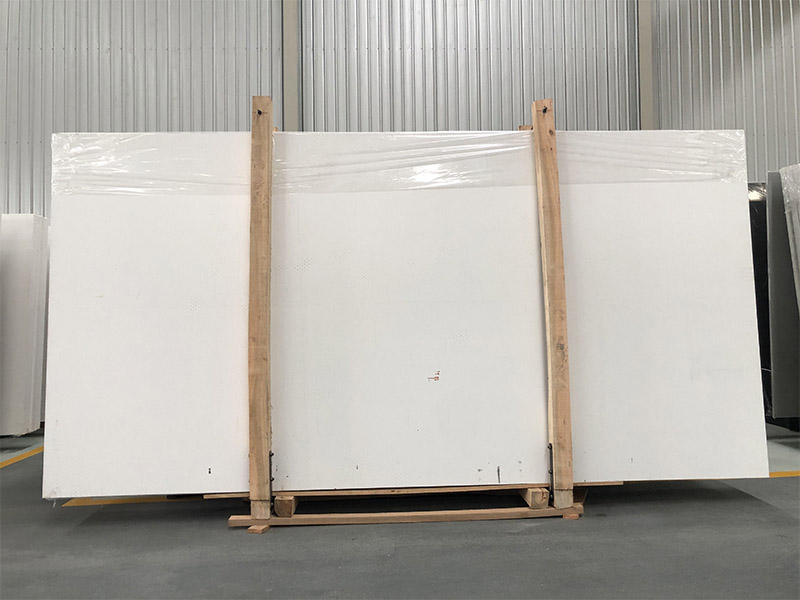
Setiap ikatan papan besar diletakkan di dalam dua bingkai kayu, satu dimasukkan dari setiap ujungnya. Kami memotong bingkai untuk ikatan tersebut, bukan dari stok ukuran standar, karena lebar bagian dalamnya harus sesuai dengan apa yang sebenarnya akan dimasukkan.
Rangka kayu berukuran 50×50 mm atau 60×60 mm, terbuat dari kayu pinus atau kayu keras. Untuk pekerjaan berat—material setebal 3 cm, format yang lebih besar—ukurannya mencapai 70×70 mm. Bagian dasar diperlebar menjadi 80×80 mm agar beban tersebar merata dan tidak menekan sepanjang dua garis kontak, dan sambungan antara tiang dan balok diberi penguat segitiga. Sambungan inilah yang paling sering rusak. Di bagian bawah, kami menyisakan jarak minimal 100 mm agar garpu forklift dapat masuk dengan bersih dan tidak pernah mengenai batu.
Lebar bagian dalam bingkai ditentukan dari total ketebalan sebenarnya dari lempengan yang masuk ke dalam bundel tersebut,ditambah 5–10 mm.
Jarak bebas itu berlaku untuk kedua arah. Jika kerangka dibuat sangat rapat, maka akan menekan batu begitu kayu mengembang atau kontainer memanas. Jika dibuat longgar, seluruh bundel akan bergerak maju mundur selama sebulan di laut. Jarak bebasnya adalah lima hingga sepuluh milimeter.
Lempengan-lempengan dimasukkan secara vertikal, sisi yang dipoles bertemu sisi yang dipoles lainnya, busa di antara kedua sisi dan busa di sekeliling tepinya. Kami mengangkat bundel tersebut, memasukkan kedua bingkai dari ujungnya, dan memeriksa celah di setiap sisi sebelum mengencangkan apa pun. Jika bingkai dan lempengan tidak terpasang rapat, bundel tersebut akan dibongkar dan disusun kembali. Mengencangkannya lebih keras tidak akan memperbaiki pemasangan yang buruk. Kemudian bingkai ditegakkan dan menjepit bundel dari atas ke bawah.
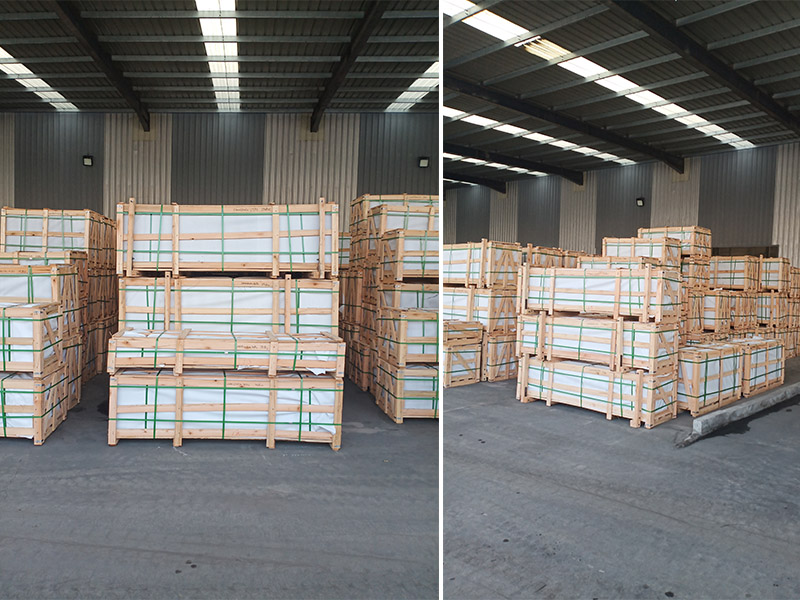
Pengikatan minimal menggunakan empat tali melintang per bundel dari PET 16 mm, titik persilangan dikunci dengan kawat besi, pelindung tepi di bawah tali agar tidak melukai pinggiran. Bundel berat membutuhkan sabuk pengikat besi 20 mm di setiap ujungnya. Berat bundel dibatasi hingga 2,5 ton, batasan yang ditentukan oleh apa yang dapat ditangani dengan aman di kedua ujung perjalanan, bukan oleh kapasitas beban rangka.
Setiap bundel diberi label di sisinya sebelum meninggalkan area pengemasan: jenis, spesifikasi, kuantitas, nomor bundel.
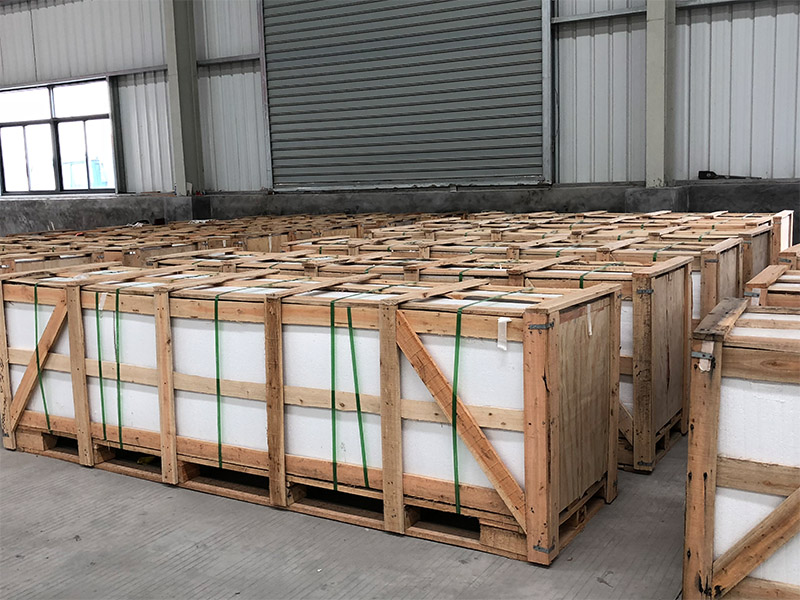
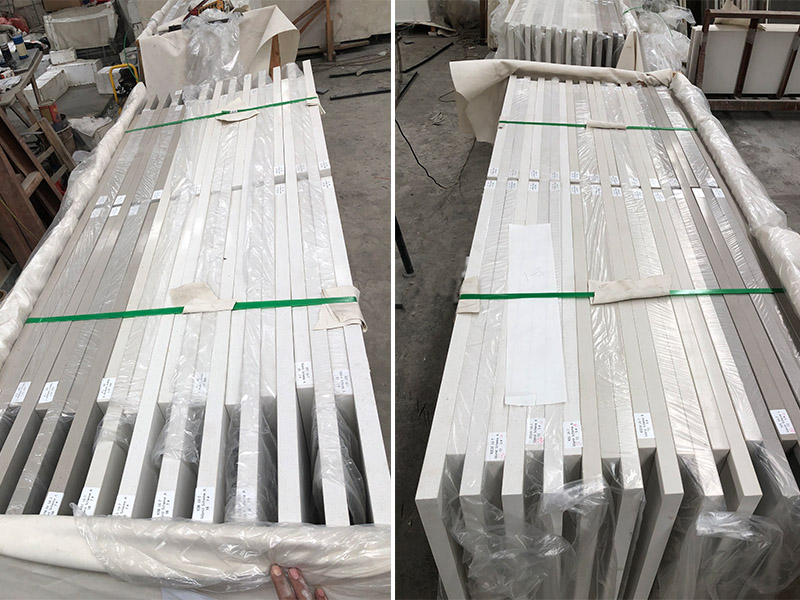
Setelah dipotong sesuai ukuran, ubin dan potongan proyek dimasukkan ke dalam peti kayu dengan berat maksimal 1,5 ton.
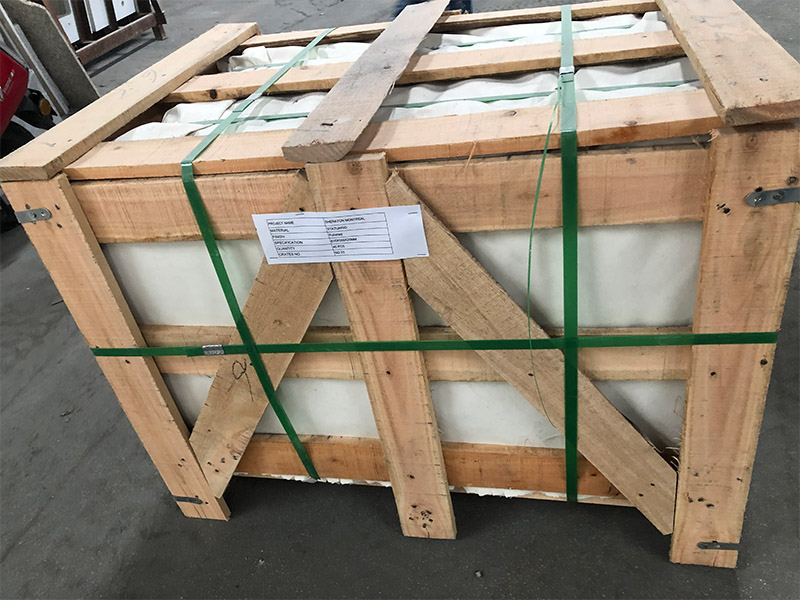
Peti dibuat dari papan dan balok standar. Bagian dasarnya setebal 18–25 mm, dan kami menambahnya menjadi 20 mm atau lebih di bagian peti yang memuat barang berat. Dindingnya setebal 12–18 mm; apa pun yang tingginya lebih dari 1,5 m menggunakan ketebalan 18 mm dengan sisi-sisi yang diperkuat. Di bagian dalam, EPE setebal 10–20 mm menutupi setiap sisi yang bersentuhan dengan batu, dengan pelindung tepi di sudut-sudutnya.
We crate the same or closely similar specifications together. Pieces stack face to face and back to back, which halves the number of polished-against-unpolished contacts and cuts friction in transit. They go in tight against each other, no gaps and no looseness. Styrofoam lines the inside of the crate. Multi-layer packing takes a board and a foam layer between each layer, and where small pieces run in several rows, a board divides every row.
Two things happen before a crate is filled. It is set down stable, or tilted slightly backwards, so pieces lean back and cannot tip out during loading. And stone waiting to be packed never sits on the floor — rubber pads or timber strips go underneath it.
Crate width is set so it divides into the 20 ft container's internal width of roughly 2.35 m. Get that wrong and you spend the loading day filling voids.
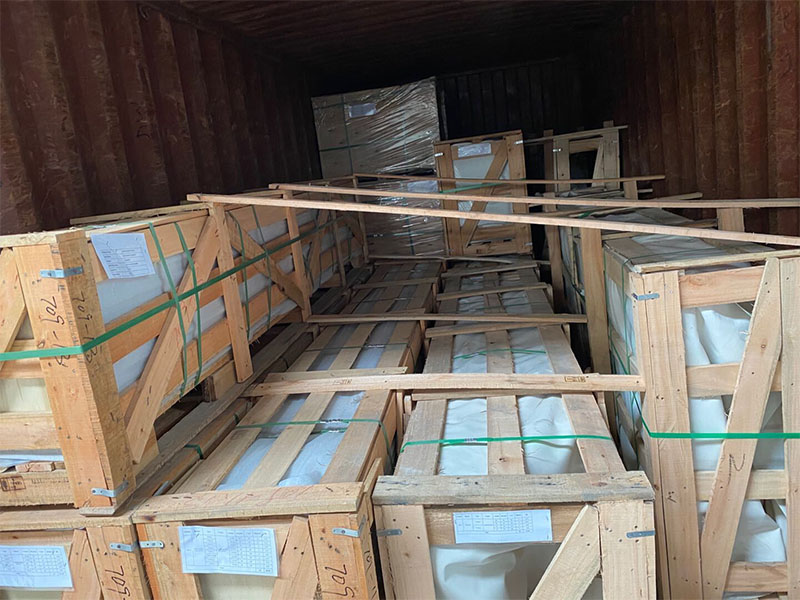
Before a crate closes, the variety, specification and quantity inside are counted against the packing list and written on a label fixed to the side.
All wood packaging leaving us is ISPM 15 compliant, fumigated with methyl bromide, and marked MB.
ISPM 15 is the IPPC standard for solid wood packaging in international trade. It recognises four treatments: heat treatment (HT, core temperature of 56 °C held for 30 minutes), methyl bromide fumigation (MB), dielectric heating (DH) and sulphuryl fluoride (SF). Ours is MB.
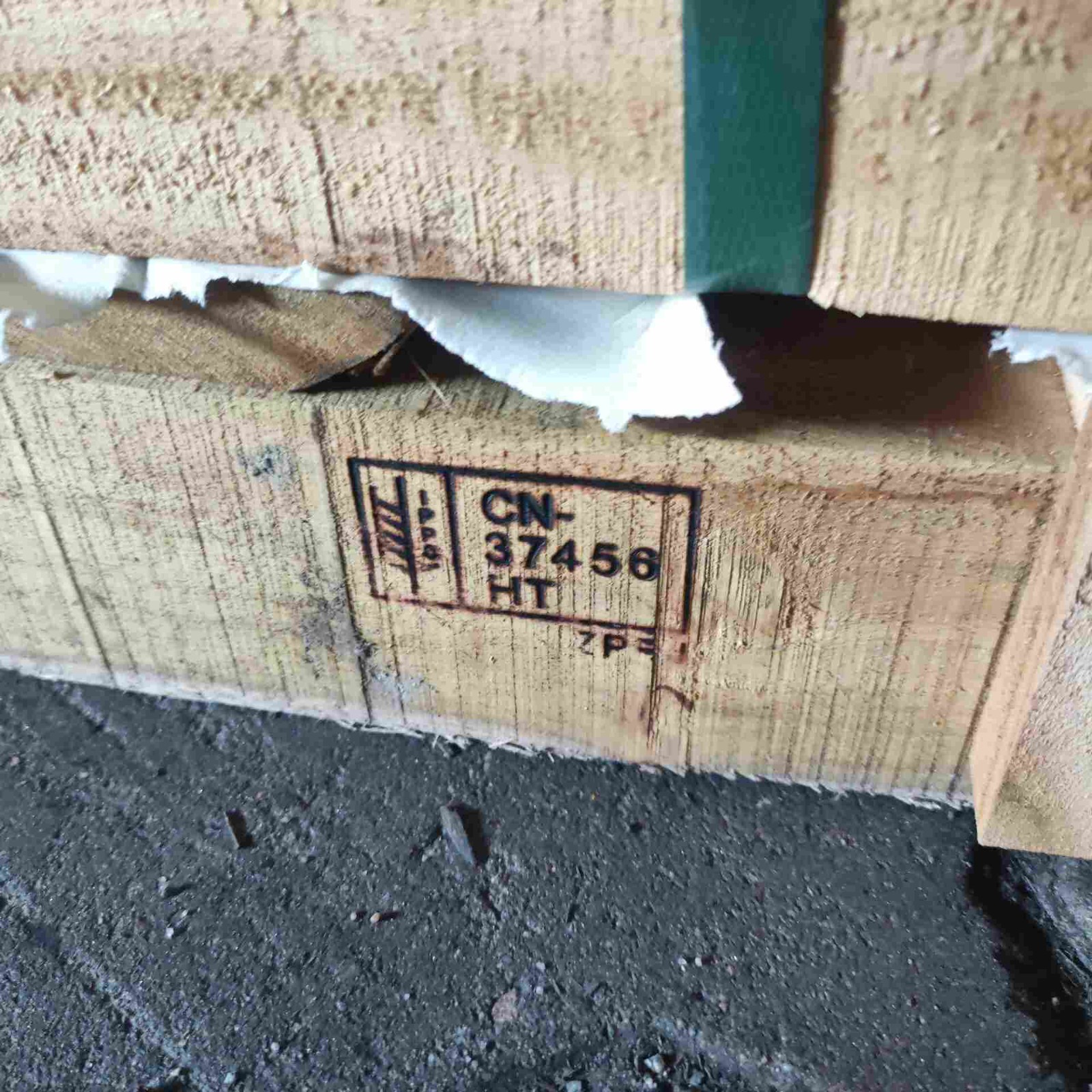
The mark itself is the compliance evidence, not a certificate sitting in a file somewhere. It carries the IPPC symbol, the two-letter ISO country code for where the wood was treated, the treatment provider's unique certification number, and the treatment abbreviation. That is what quarantine reads at the border. We can send you a photograph of it with the treatment documentation for your shipment.
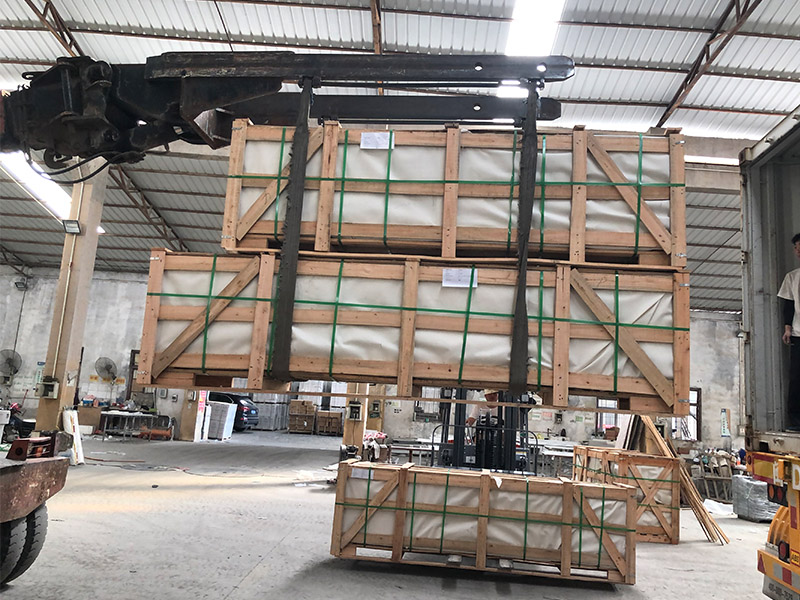
A container of marble hits its weight limit while it is still less than half full, so loading marble is a weight problem before it is a space problem.
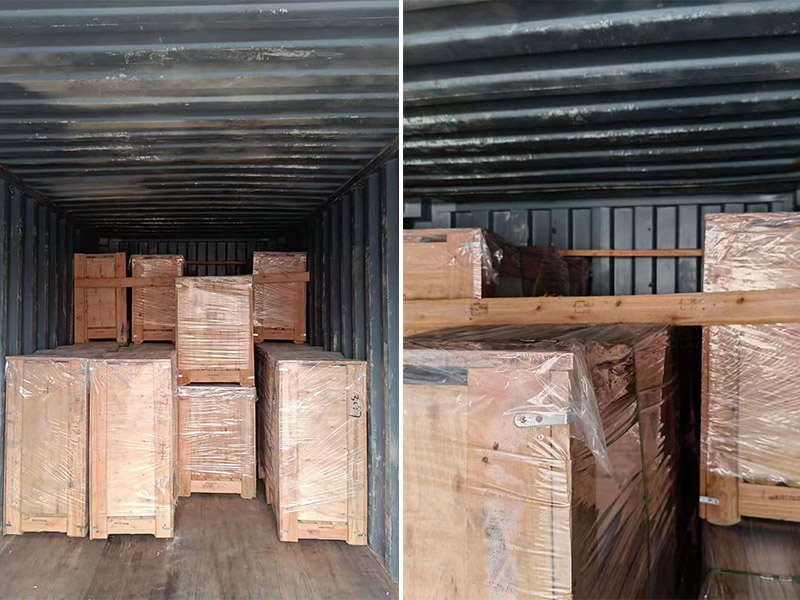
Bundles go in along the centre line and spread down the length of the container, so the weight is not sitting over one axle position. That is what keeps the box legal on the road at the far end, not just safe at sea.
We stack staggered, not in straight columns, so vertical load is not running through a single line of frames. Anti-slip rubber strips go between bundles. Voids get braced and filled at loading — a void left alone closes up at sea, and the load shifts with it.
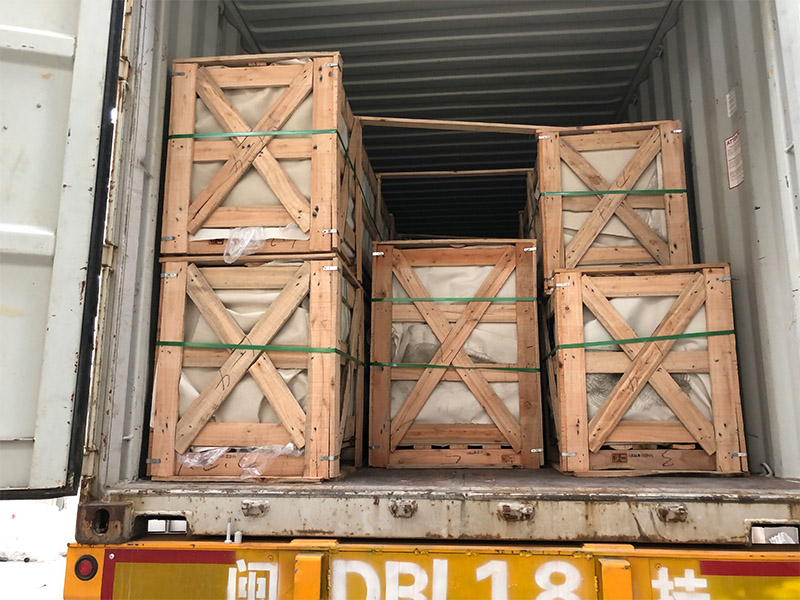
Crates carry a centre-of-gravity mark, lifting points and a moisture label, so whoever opens the container at the other end is not guessing. For securing and weight distribution we work to the IMO/ILO/UNECE CTU Code, which is the international reference for packing cargo transport units.
Short answer:a 20 ft container takes 8–12 bundles at 18–22 tonnes net, which is roughly 330–410 m² in 2 cm or 220–270 m² in 3 cm.
The longer answer matters more, because the figures published for this vary so widely that they are hard to use. Four things move the number: slab format, thickness, the weight of the packing itself, and the road weight limit at the destination. Here is how to work it out for your own order.
Marble runs at roughly 2.7 tonnes per cubic metre. That gives:
At the two common big-slab formats:
| Slab format | Area | Weight at 2 cm | Weight at 3 cm |
|---|---|---|---|
| 2400 × 1200 mm | 2.88 m² | approx. 156 kg | approx. 233 kg |
| 3000 × 1500 mm | 4.50 m² | approx. 243 kg | approx. 365 kg |
1. The container.A 20 ft box is rated at about 30,480 kg gross. Tare runs 2,200–2,400 kg, so structural payload lands around 28,000 kg.
2. The road limit at the destination.This is almost always the real constraint, and it is why published container figures differ so much. In the United States the federal Interstate limit is 80,000 lb gross vehicle weight, with 20,000 lb on a single axle and 34,000 lb on a tandem. Take out tractor, chassis and container tare, and the cargo weight buyers work to sits well under the container's structural payload. European and Australian limits bite the same way at different numbers.
3. The packing.Timber frames and crates are part of the gross weight. They are not free carriage.
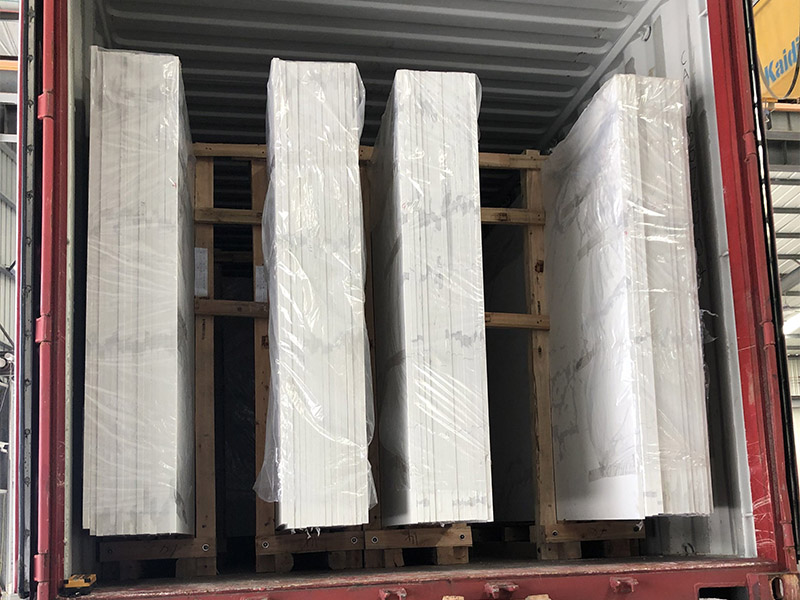
A 20 ft container of marble big slabs normally takes8–12 bundles at 18–22 tonnes net. Against the figures above, that is roughly330–410 m² in 2 cm, or220–270 m² in 3 cm. Exact quantity depends on the format and thickness you order; formats vary between different marble materials, and so does the number of slabs a bundle will take.
Tell us the road weight limit you work to at your destination and we load to it. That is a much cheaper conversation before the container is booked than after it is turned away at the port.
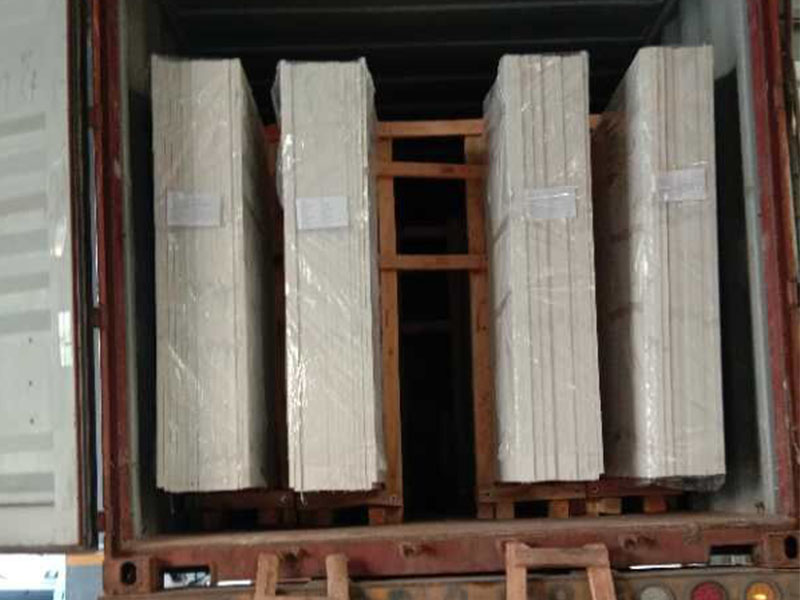
At 2.7 t/m³ a 40 ft container reaches its weight limit long before it is full, so you pay freight on space you cannot fill. Marble moves in 20 ft boxes for the same reason blocks do. A 40 ft only makes sense on lighter or lower-density material.
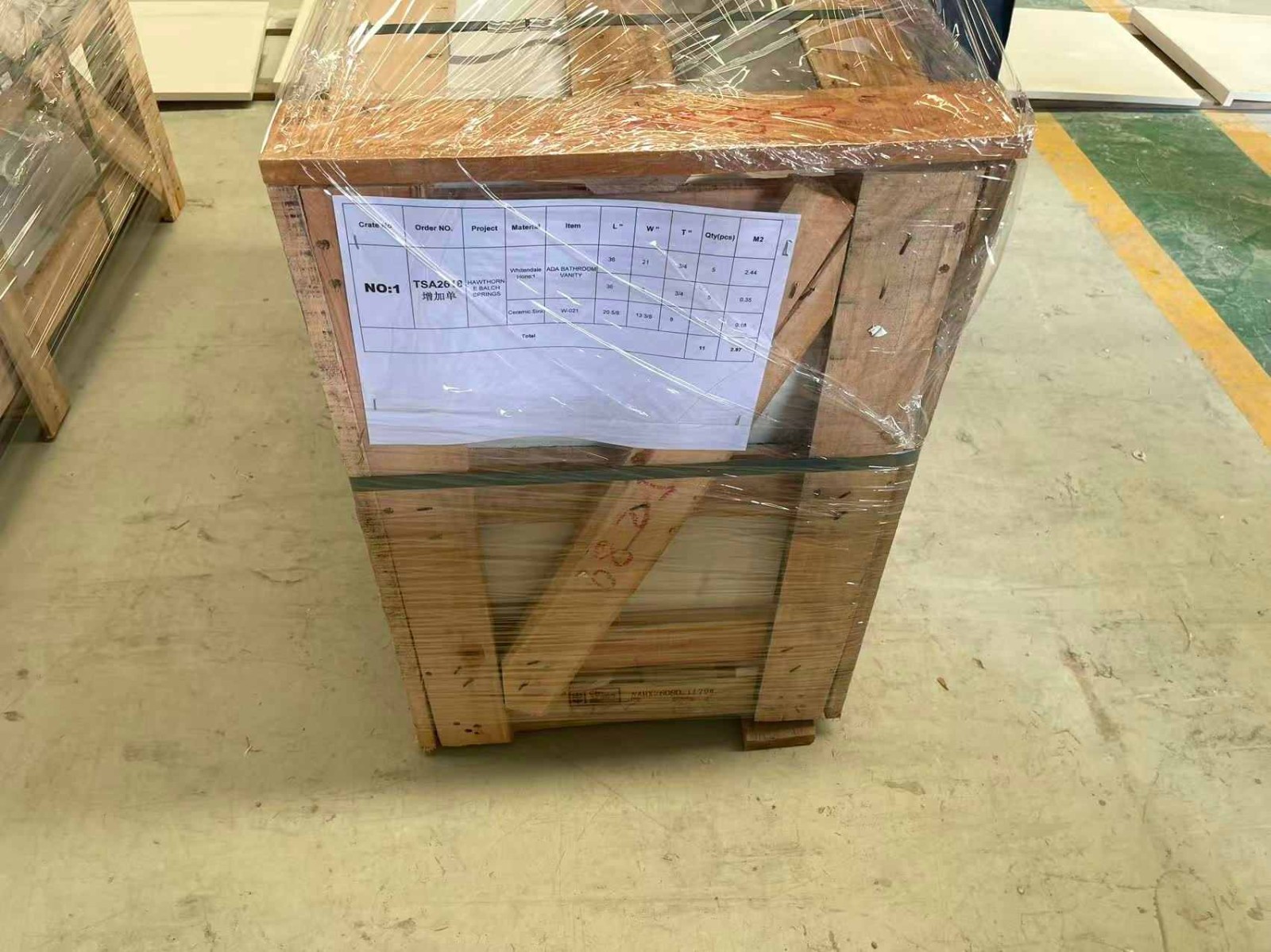
Nothing is packed until it has passed final inspection, and nothing is sealed until QC has signed for it.
Pieces are counted against the packing list, cleaned, and visually checked. Anything that fails goes back to QC and the workshop to be remade. The packer records what went into each crate and bundle, and a QC inspector confirms and signs before the crate closes. That is part ofour serviceon every order.
What it leaves you holding:
If a claim ever has to be made, this is the paperwork that settles it quickly, and it costs nothing to have it on file.
Everything above is our standard build. It can be adjusted, and order stage is when to say so — not once the container is booked.
Specify none of it and you get the standard build above, which is set up for a normal 20 ft ocean shipment.
Is your wood packaging ISPM 15 compliant?
Yes. All crates and frames are ISPM 15 compliant and fumigated with methyl bromide. Each one carries the IPPC mark showing the country code, the certification number and the MB treatment code.
How many marble slabs fit in a 20 ft container?
A 20 ft container of big slabs normally takes 8–12 bundles at 18–22 tonnes net, which works out at roughly 330–410 m² in 2 cm or 220–270 m² in 3 cm. The limit is weight, not space.
Can you load to our destination's weight limit?
Yes. Tell us the limit you work to and we load the container to that figure instead of to its structural capacity.
Do you heat treat or fumigate the timber?
We fumigate with methyl bromide. The IPPC mark on the timber carries the MB code. ISPM 15 also recognises heat treatment, dielectric heating and sulphuryl fluoride, and any of the four is valid for import.
Why does marble ship in 20 ft containers rather than 40 ft?
Marble weighs about 2.7 tonnes per cubic metre. A 40 ft container reaches its weight limit well before it is full, so the extra space cannot be used and you pay freight on it anyway.
What should we do if slabs arrive damaged?
Foto kemasan sebelum dibuka, lalu foto kerusakan di tempatnya berada di dalam peti atau bundel. Kirimkan foto-foto tersebut bersama dengan foto pemuatan dan daftar kemasan dari pengiriman. Mencocokkan kondisi saat tiba dengan kondisi saat pemuatan adalah hal yang membuat klaim mudah diselesaikan, itulah mengapa catatan pemuatan penting untuk disimpan bahkan ketika tidak ada masalah.
Bisakah kami menentukan kemasan sendiri?
Ya. Kemasan dapat dibuat sesuai kebutuhan Anda. Beri tahu kami pada tahap pemesanan dan kami akan mengkonfirmasi spesifikasinya sebelum produksi dimulai.
Kirimkan kepada kami materi, format, dan alamat tujuan.
Kami akan segera memberikan spesifikasi pengemasan dan jumlah kontainer untuk pesanan Anda, sehingga Anda mengetahui berat muatan sebelum memesan kontainer.Hubungi kami.
 ROOM 205,NO.45, MIDDLE HAIJING ROAD,XIAMEN,AREA OF PILOT FREE TRADE ZONE(FUJIAN)OF CHINA
Untuk Pertanyaan tentang produk atau daftar harga kami, silakan tinggalkan kepada kami dan kami akan berhubungan dalam 24 jam.



© hak cipta: 2026 XIAMEN EXCELLENT STONE CO.,LTD. Seluruh hak cipta.

Jaringan IPv6 didukung